
ACCOUNTABILITY LAB PAKISTAN
AL Pakistan has expanded our programs to include capacity building and accountability leadership training for local governments, in addition to our core programs including Integrity Icon and the Accountability Incubator. The regions we work in include some of the most neglected areas in Sindh and Khyber Pakhtunkhwa.
The AL Pakistan team has worked with more than 30,000 participants over the past year, successfully implementing our Integrity Innovation Lab, Accountability Incubator, Civic Action Teams and Integrity Icon. Through our programs, more than 350 government officials were trained on good governance, solidifying their commitment to accountability and transparency in their work. The Youth Peace Incubation program saw the participation of over 3,000 young individuals, 55% of them women, who were introduced to groundbreaking ideas to contribute to the peace of society effectively. To build community resilience to Covid-19, AL Pakistan engaged 339 women leaders who reached out to vulnerable and high-risk populations to help them cope with ongoing challenges linked to the Covid-19 pandemic. Read more about our work below.
WHAT WE DO
LATEST NEWS




LATEST PODCASTS
LATEST PODCASTS
WHAT’S HAPPENING


Pakistan’s think tanks produce research on critical policy issues, yet their findings often struggle to reach government decision-makers, inform public debate or influence policy formulation. What would it take to bridge this gap between research and policymaking?
In this episode of Read moreAccountabiliTea Podcast, Dr. Shafqat Munir Ahmad , Head of the Resilient Development Program at the Sustainable Development Policy Institute (SDPI), and Dr. Ali Salman, Chief Executive Officer of the Policy Research Institute of Market Economy (PRIME), examine the practical relevance of think tanks in Pakistan’s policy landscape. The discussion explores their limited influence on government decision-making, questions of public and institutional credibility, the disconnect between research and policy priorities, and the need to strengthen collaboration between think tanks, government, universities and local institutions.
Watch the full episode to explore how Pakistan can build stronger links between policy research and decision-making, ensuring that evidence informs public priorities and contributes to more responsive policymaking.
What role can think tanks play in shaping Pakistan’s policy priorities and translating research into meaningful change?
In this episode of AccountabiliTea Podcast, Dr. Shafqat Munir , Head of the Resilient Development Program at SDPI, and Dr. Ali Salman, Chief Executive Officer of PRIME,Read more discuss the challenges facing Pakistan’s think tank ecosystem, its engagement with policymakers and opportunities to make research more responsive to public needs.
Podcast coming today


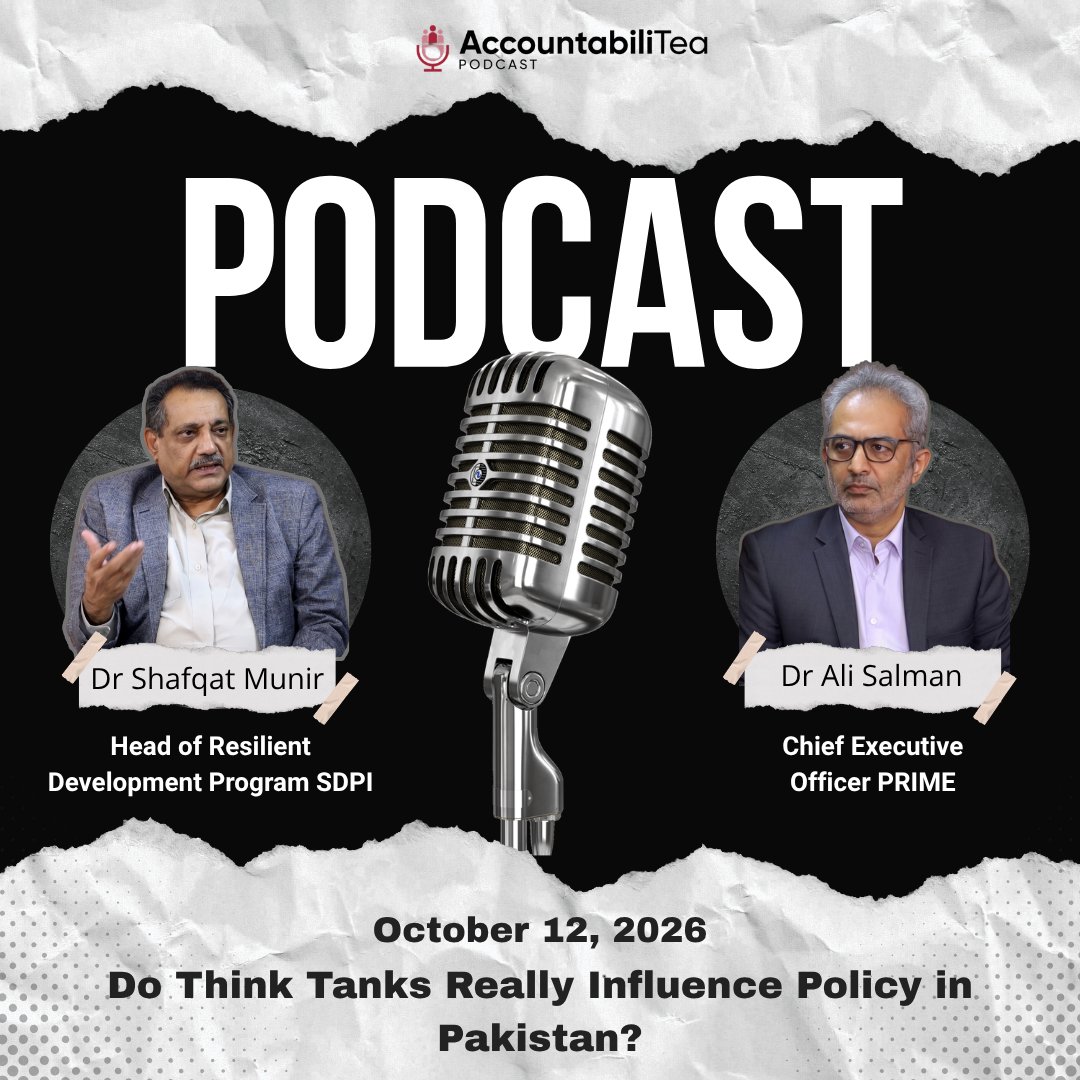
How can think tanks shape Pakistan’s policy priorities & bridge the gap between research & policymaking?
Dr. Shafqat Munir Ahmad (SDPI) and Dr. Ali Salman (PRIME) discuss the challenges and opportunities for Pakistan’s think tank ecosystem.
AccountabiliTea Podcast dropping Read moretoday!

As PTI’s march brings questions of provincial governance to the forefront, barriers to polio vaccination persist in Bannu with 5 cases arising in 2026 across Pakistan and 131 potentially dangerous glacial lakes have been identified across Khyber Pakhtunkhwa and Gilgit Baltistan.
Explore Read morethese developments and more in our latest Country Analysis Report.
Link: https://pakistan.accountabilitylab.org/wp-content/uploads/2026/10/CAR-Sept-16th-30th-2026.pdf

PTI’s march brings questions of provincial governance to the forefront and barriers to polio vaccination persist in Bannu with 5 cases arising in 2026 across Pakistan.
1/2

What would it take for local governments and think tanks to work together to address Pakistan’s development challenges?
Dr. Shafqat Munir Ahmad, Deputy Executive Director (Policy) and Head of the Sustainability and Resilience Programme at the Sustainable Development Policy Institute, Read morediscusses the importance of decentralising policy research, building local institutional capacity and creating demand for evidence-based solutions.
Stay tuned for our upcoming podcast, “The Role and Relevance of Think Tanks and Their Work in Pakistan,” for an insightful discussion on local governance, policy research and the role of think tanks in shaping development.